Analysis of the Major Wind Learning Method in Mastering Embouchure Techniques on the Flute Instrument
DOI:
https://doi.org/10.24036/jsu.v15i2.75Keywords:
Learning Methods, Wind Instrument Major, Embouchure, FluteAbstract
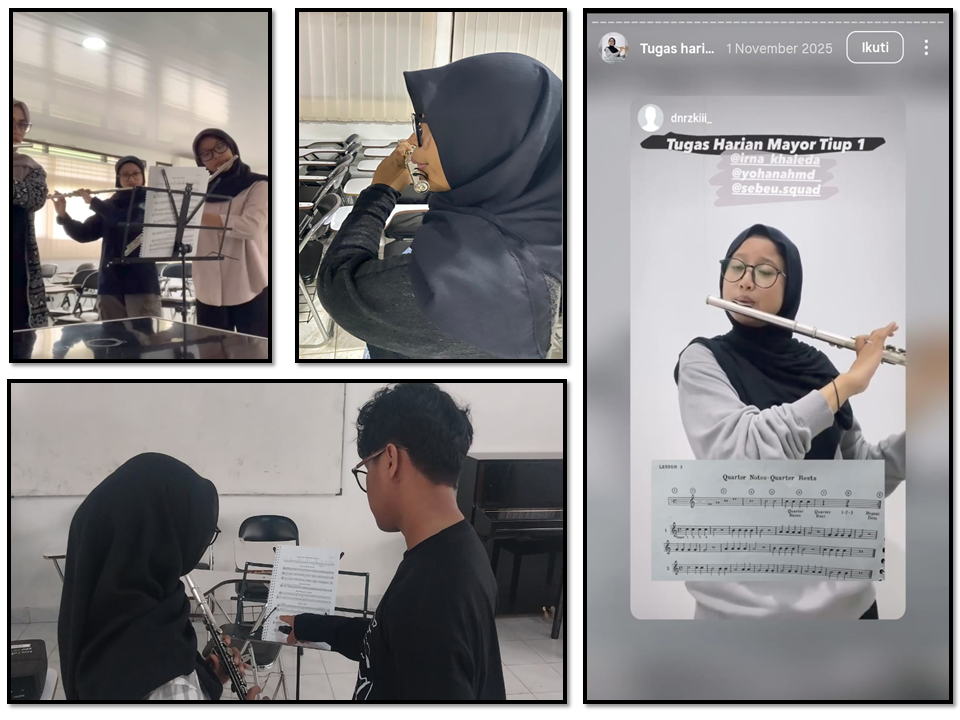
This study aims to analyze the learning methods used in wind instrument major classes to help students master the basic embouchure technique on the flute. Embouchure is a fundamental aspect of flute playing as it directly affects sound quality, tone stability, and breath control. Common problems in flute learning include students’ lack of understanding of lip positioning, airflow direction, and coordination between breathing and articulation. A descriptive method within a qualitative approach was adopted for this study. Data were collected through observations of the learning process, interviews with peer teacher and students, and documentation of practice activities at the Music Education Study Program, University of Lampung. The results indicate that demonstration and repetitive practice methods are effective in helping students understand and master the embouchure technique, as reflected in improved sound stability and breath control. Therefore, the implementation of appropriate learning methods can enhance students’ fundamental technical skills in flute performance.
References
Agustianto. (2015). Kontribusi Prinsip-pinsip Pengajaran dalam Praktik Instrumen Musik Gesek. Imaji: Jurnal Seni Dan Pendidikan Seni, 13(2). https://doi.org/10.21831/imaji.v13i2.7888
Arry, C., Fretisari, I., & Muniir, A. (2019). Efektivitas Penerapan Metode Demonstrasi Terhadap Permainan Musik Ansambel pada Siswa Kelas VII. Jurnal Pendidikan Dan Pembelajaran Khatulistiwa (JPPK), 8(8). https://doi.org/10.26418/jppk.v8i8.34509
Boud, D., & Molloy, E. (2013). Rethinking models of feedback for learning: The challenge of design. Assessment & Evaluation in Higher Education, 38(6), 698–712. https://doi.org/10.1080/02602938.2012.691462
Bulut, S. (2015). A Comparison of the First Three Flute Lessons with Beginner and Intermediate-advanced Level Flute Students. Procedia - Social and Behavioral Sciences, First Global Conference on Contemporary Issues in Education (GLOBE-EDU 2014) 12-14 July 2014, Las Vegas, USA, 177, 229–234. https://doi.org/10.1016/j.sbspro.2015.02.397
Clemente, M. P., Moreira, A., Mendes, J., Ferreira, A. P., & Amarante, J. M. (2019). Wind Instrumentalist Embouchure and the Applied Forces on the Perioral Structures. https://doi.org/10.2174/1874210601913010107
Dewantara, P., & Utomo, U. (2019). Strategi Khusus Pembelajaran Flute Kelas X SMK Negeri 2 Kasihan Bantul Yogyakarta. Jurnal Seni Musik, 8(1), 1–6. https://doi.org/10.15294/jsm.v8i1.25784
Fiantika, F., Wasil, M., Jumiyati, S., Honesti, L., Wahyuni, S., Mouw, E., Jonata, Mashudi, I., Hasanah, N., Maharani, A., Ambarwati, K., Noflidaputri, R., Nuryami, & Waris, L. (2022). Metodologi Penelitian Kualitatif.
Istiqomah, R. A. (2021). Model Pembelajran Flute Pada Siswwa KelasS 6 Di SekolahH Dasar Kristen Bina BaktI 2 Matius Bandung.
Kasimova, S. K. (2026). PEDAGOGICAL FOUNDATIONS OF FORMING BREATHING TECHNIQUE AND SOUND CULTURE IN FLUTE PERFORMANCE. International Journal of Law, 6(6), 34–37. https://doi.org/10.5281/zenodo.20547236
Lestari, W. R., Wahyudin, U. R., & Abidin, J. (2021). Efektivitas Penerapan Metode Drill dalam Pembelajaran Pendidikan Agama Islam. Jurnal Pendidikan Tambusai, 5(2), 3847–3851. https://doi.org/10.31004/jptam.v5i2.1485
Murbiyantoro. (2021). The Importance of Embouchure Technique on Flute Major Course in Universitas Negeri Surabaya. ResearchGate. https://doi.org/10.2991/assehr.k.211223.012
Panadero, E., & Lipnevich, A. A. (2022). A review of feedback models and typologies: Towards an integrative model of feedback elements. Educational Research Review, 35, 100416. https://doi.org/10.1016/j.edurev.2021.100416
Pane, A., & Dasopang, M. D. (2017). BELAJAR DAN PEMBELAJARAN. FITRAH: Jurnal Kajian Ilmu-Ilmu Keislaman, 3(2), 333–352.
Prabasumirat, R. M. (2025a). Long Note, Embouchure, dan Kualitas Suara (Studi Kasus: Analisis Latihan Long Note terhadap Pembentukan Embouchure dan Kualitas Suara pada Pemain Flute). Repertoar Journal, 5, 317–323. https://doi.org/10.26740/rj.v5n2.p317-323
Prabasumirat, R. M. (2025b). Long Note, Embouchure, dan Kualitas Suara (Studi Kasus: Analisis Latihan Long Note terhadap Pembentukan Embouchure dan Kualitas Suara pada Pemain Flute). Repertoar Journal, 317–323. https://doi.org/10.26740/rj.v5n2.p317-323
Sandi, N. K., Astuti, F., & Ardipal. (2026). SINTESIS LITERATUR SISTEMATIS EFEKTIVITAS PROJECT-BASED LEARNING DALAM MENYEIMBANGKAN PEMAHAMAN TEORI MUSIK DAN KETERAMPILAN PRAKTIK INSTRUMEN. Pendas : Jurnal Ilmiah Pendidikan Dasar, 11(01), 147–167. https://doi.org/10.23969/jp.v11i01.41431
Son. (2023). Analysis of Embouchure and Aperture in Flute Pedagogies, Muscle Studies, and Empirical Studies. http://rave.ohiolink.edu/etdc/view?acc_num=ucin170317225267095
Streitova, M. (2022). Quarter-tones, Glissandi and their Benefits in Flute Embouchure and Tuning. Bulletin of the Transilvania University of Braşov. Series VIII: Performing Arts, 107–118. https://doi.org/10.31926/but.pa.2022.15.64.2.12
Tambak, S. (2016). Metode Drill dalam Pembelajaran Pendidikan Agama Islam. Al-Hikmah: Jurnal Agama Dan Ilmu Pengetahuan, 13(2), 110–127. https://doi.org/10.25299/al-hikmah:jaip.2016.vol13(2).1517
VanderLugt, J. (2023). Approaching Fifth to Sixth Grade Flute Pedagogy Considering VARK Learning Styles Model. Senior Honors Theses. https://digitalcommons.liberty.edu/honors/1309
Wan, L., Crawford, R., & Jenkins, L. (2023). Digital listening tools to facilitate children’s self-regulation of instrumental music practice. Journal of Research in Music Education, 71(1), 67–90. https://doi.org/10.1177/00224294221093521
Wisniewski, B., Zierer, K., & Hattie, J. (2020). The Power of Feedback Revisited: A Meta-Analysis of Educational Feedback Research. Frontiers in Psychology, 10, 3087. https://doi.org/10.3389/fpsyg.2019.03087
Downloads
Published
Issue
Section
License
Copyright (c) 2026 Rizka Sepfindra & Riyan Hidayatullah

This work is licensed under a Creative Commons Attribution-NonCommercial-ShareAlike 4.0 International License.