Intermedial Transformation: Generative Artificial Intelligence-Based Choreography Learning Strategies for Students at Parongpong 1 Public High School
DOI:
https://doi.org/10.24036/jsu.v14i4.55Keywords:
generative AI, dance education, intermedial transformation, text-to-movement, motion interpolation, collaborative learningAbstract
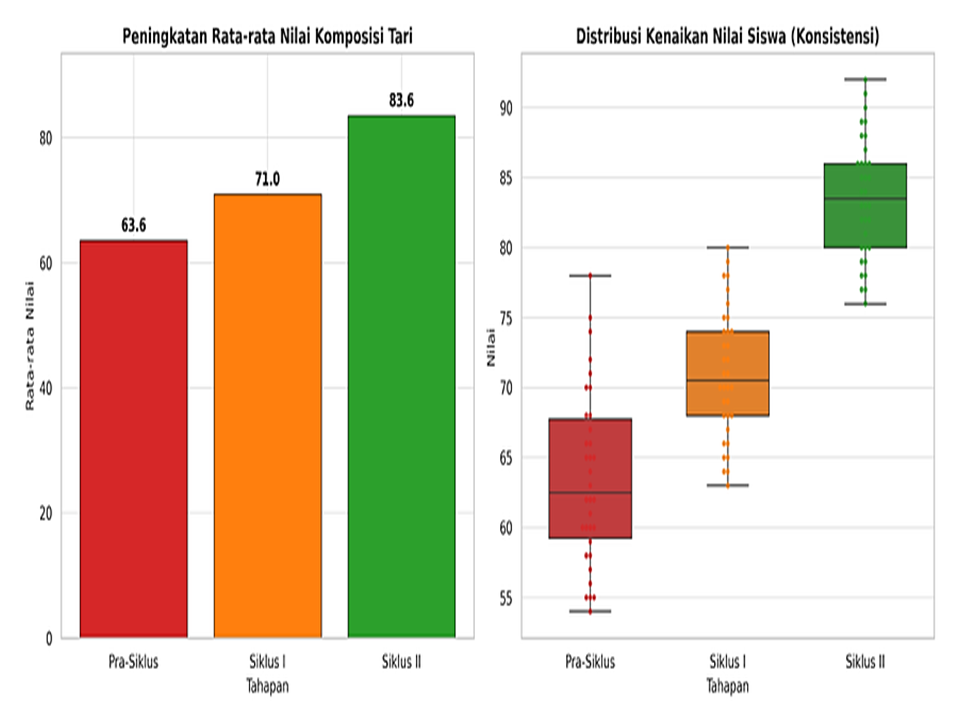
The dominance of visual culture among Generation Z students often traps the dance learning process in mimesis practices that hinder the emergence of originality in movement. This study applies an Intermedial Transformation strategy through a Text-to-Movement Translation approach based on Generative AI to respond to this creative stagnation. Using a mixed Classroom Action Research (CAR) design on 34 students at Parongpong 1 Public High School, the intervention was carried out in two cycles: the use of textual AI (ChatGPT) and visual-kinesthetic AI (Living Archive). The results showed a significant increase in composition creativity scores: 63.5 (Pre-Cycle), 71.4 (Cycle I), and 83.8 (Cycle II). The main finding of this study was a shift in the mode of creation from dynamic imitation to static reconstruction. Through the AI-facilitated motion interpolation process, students activated their kinesthetic intelligence to arrange digital poses into complete dance compositions. This proves that targeted AI integration can function as a collaborative partner (co-creator) that stimulates originality without reducing human agency in the creative process.
References
Badan Pusat Statistik Provinsi Jawa Barat. (2025). Provinsi Jawa Barat Dalam Angka 2025. Badan Pusat Statistik Provinsi Jawa Barat.
Bench, H. (2020). Perpetual motion: Dance, digital cultures, and the common. University of Minnesota Press.
Chapple, F., Kattenbelt, C., & International Federation for Theatre Research (Ed.). (2007). Intermediality in theatre and performance (3. ed). Rodopi.
Citrawati, Ninon Syofia, & Wahida Wahyuni. (2023). Transformasi Pendidikan Seni melalui Teknologi: Memperluas Horison Kreativitas dalam Pembelajaran Seni Tari. Jurnal Pendidikan Teknologi Informasi dan Vokasional, 5(1).
deLahunta, S. (2017). Dance Becoming Data: Part OneSoftware for Dancers. Computational Culture 6. http://computationalculture.net/dance-becoming-data-part-one-software-for-dancers/
Delahunta, S., Barnard, P., & Mcgregor, W. (2012). Augmenting choreography: Insights and inspiration from science: Scott Delahunta, Phil Barnard and Wayne Mcgregor. Dalam J. Butterworth & L. Wildschut (Ed.), Contemporary Choreography: A Critical Reader (0 ed.). Routledge. https://doi.org/10.4324/9780203124918
Dimock, M. (2019, Januari 17). Defining generations: Where Millennials end and Generation Z begins. Pew Research Center. https://www.pewresearch.org/short-reads/2019/01/17/where-millennials-end-and-generation-z-begins/
Firat, M. (2023). How Chat GPT Can Transform Autodidactic Experiences and Open Education? Open Science Framework. https://doi.org/10.31219/osf.io/9ge8m
Hawkins, A. M. (1991). Moving from within: A new method for dance making. Cappella Books : Distributed by Independent Publishers Group.
Jazuli, M. (2008). Paradigma kontekstual pendidikan seni. Unesa University Press.
Kemmis, S., & McTaggart, R. (2005). Participatory Action Research: Communicative Action and the Public Sphere. Dalam N. Denzin & Y. Lincoln (Ed.), The Sage Handbook of Qualitative Research (hlm. 559–603). Sage, Thousand Oaks.
Krstić, L., Aleksić, V., & Krstić, M. (2022). Artificial Intelligence in Education: A Review. Proceedings TIE 2022, 223–228. https://doi.org/10.46793/TIE22.223K
Leijen, Ä., Lam, I., Simons, P. R.-J., & Wildschut, L. (2008). Pedagogical practices of reflection in tertiary dance education. European Physical Education Review, 14(2), 223–241. https://doi.org/10.1177/1356336X08090707
Li, Z., & Wong, K. K. (2023). Challenges and Opportunities: Dance Education in the Digital Era. Dalam C. Hong & W. W. K. Ma (Ed.), Applied Degree Education and the Shape of Things to Come (hlm. 29–48). Springer Nature Singapore. https://doi.org/10.1007/978-981-19-9315-2_2
Lubart, T. (2005). How can computers be partners in the creative process: Classification and commentary on the Special Issue. International Journal of Human-Computer Studies, 63(4–5), 365–369. https://doi.org/10.1016/j.ijhcs.2005.04.002
Manik, S. I. (2023). Analisis Pola Kreativitas Visual Penggunaan Prompt pada AI Image Generator. Kecerdasan Buatan Dan Seni, 2.
Manovich, L. (2001). The language of new media (8. print). MIT Press.
Mazzone, M., & Elgammal, A. (2019). Art, Creativity, and the Potential of Artificial Intelligence. Arts, 8(1), 26. https://doi.org/10.3390/arts8010026
Miles, M. B., & Huberman, A. M. (1994). An Expanded Sourcebook: Qualitative Data Analysis. SAGE Publications Ltd.
Prensky, M. (2001). Digital Natives, Digital Immigrants Part 1. On the Horizon, 9(5), 1–6. https://doi.org/10.1108/10748120110424816
Rasyid, R. E., Aisa, S., Ramlan, P., Jamaluddin, Sadapotto, A., Mustanir, A., Kasman, N., & Masnawati. (2024). Pendampingan Penyusunan Modul Berbasis Artificial Intelligence di SMK Negeri Seni dan Budaya. Jurnal Madaniya, 5(4), 1663–1668. https://doi.org/10.53696/27214834.973
Sahnir, N., Jamilah, & Yatim, H. (2023). Pengenalan Teknologi Artificial Intelligence (AI) dalam Meningkatkan Pengalaman Belajar Seni di Era Digitalisasi Pendidikan. SEMINAR NASIONAL DIES NATALIS 62, 1, 245–256. https://doi.org/10.59562/semnasdies.v1i1.811
Saskia, N. L., & Yuliasma, Y. (2021). Strategi Pembelajaran Seni Tari Di SMA Negeri 8 Kota Padang. Jurnal Sendratasik, 10(4).
Seemiller, C., & Grace, M. (2016). Generation Z goes to college. Jossey-Bass.
Selwyn, N. (2016). Is technology good for education? Malden, MA : Polity Press.
Smith-Autard, J. M. (2002). The art of dance in education (2. ed). A. & C. Black.
UNESCO. (2025, April 14). Guidance for generative AI in education and research. https://www.unesco.org/en/articles/guidance-generative-ai-education-and-research
Wilcox, D. (2010). Closer: Performance, Technologies, Phenomenology. By Susan Kozel. Cambridge, MA: The MIT Press, 2008. Pp. 362. $35/£22.95 Hb. Theatre Research International, 35(1), 87–88. https://doi.org/10.1017/S0307883309990502
Woodward, P. (2008). Digital Practices: Aesthetic and Neuroesthetic Approaches to Performance and Technology (Palgrave Macmillan 2007) by Susan Broadhurst. Body, Space & Technology, 7(2). https://doi.org/10.16995/bst.147
Xia, Z. (2025). Research on digital and blended education modes of dance education under the perspective of international education—Review based on theoretical literature. SHS Web of Conferences, 222, 04014. https://doi.org/10.1051/shsconf/202522204014
Yusna, S. N., Masliyah, & Wibisana, H. (2025). Peningkatan Kreasi Peserta didik Sekolah Dasar Lewat Design Gambar Dengan Pemanfaatan Google Artificial Intelligence. Jurnal Abdi Karya Sipil, 1(2). https://doi.org/10.33005/jaksi.v1i2.8
Downloads
Published
Issue
Section
License
Copyright (c) 2025 Fitri Nurhaetin

This work is licensed under a Creative Commons Attribution-NonCommercial-ShareAlike 4.0 International License.