Dramaturgical Work in the Role-Creation Process: A Study of Character Building in Five Realist Theater Performances
DOI:
https://doi.org/10.24036/jsu.v15i3.113Keywords:
dramaturgical work, character analysis, building character, creating a role, realismAbstract
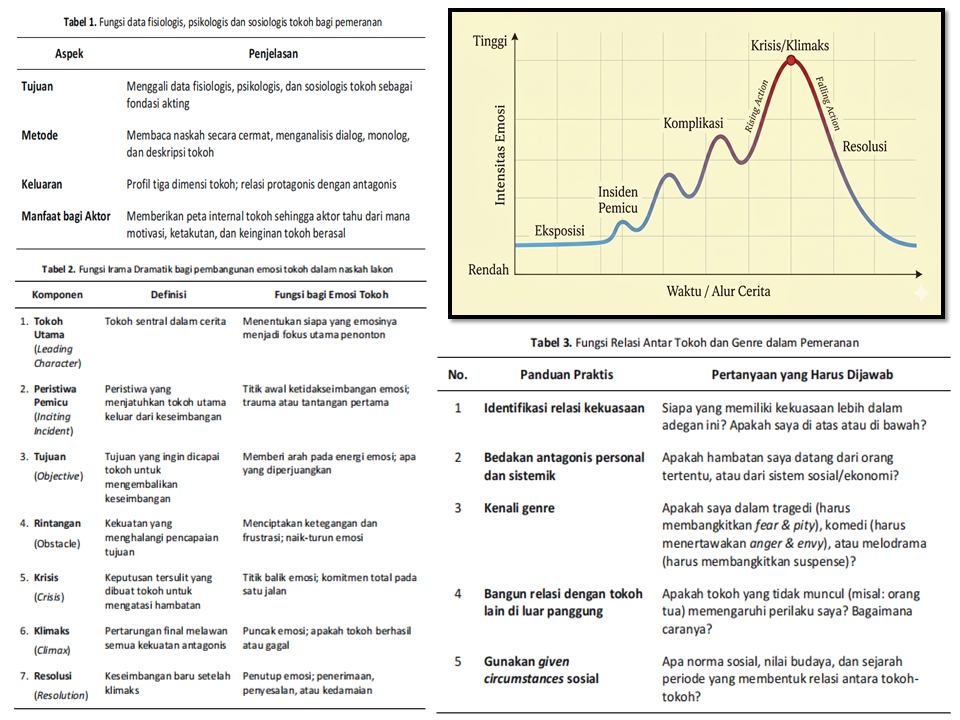
This article stems from observations of the challenges actors face in portraying characters in realist-style, tragedy-genre plays. These observations reveal a gap between the actors' understanding of the characters in the script and their performance execution on stage. This gap arises from the fact that some actors merely memorize the dialogue without first understanding and deeply exploring the character's dimensions. The purpose of this article is to bridge the gap between dramaturgical findings and the methodological solutions that can be offered to actors. This is pursued by identifying and formulating the specific role of the dramaturg as a process companion for actors; and, more broadly, by formulating dramaturgical work as a supporting tool for analyzing, understanding, and comprehensively building a character. This article employs a qualitative method with a case study approach, written based on the practice of mentoring five acting processes. The scripts examined are all realist in style and tragic in genre. The research findings indicate that three types of dramaturgical work assist in character building and role creation, namely: 1)diagnostic work; 2)structural work; and 3)contextual work, which operate synergistically and complement one another. The conclusion of this study suggests that a dramaturg can be employed as a process companion for actors, particularly in relation to the understanding that dramaturgical work can strengthen the acting paradigm from “merely memorizing dialogue” to “bringing the character to life.”
References
Aristoteles. (2017). Puitika: Seni Puisi. Basa Basi.
Cardullo, R. J. (2015). Play Analysis: A Casebook on Modern Western Drama. Sense Publisher. https://doi.org/10.1007/978-94-6300-280-6
Chemers, M. M. (2010). Ghost Light: An Introductory Handbook for Dramaturgy. Southern Illinois University Press.
Dewojati, C. (2010). Drama: Sejarah, Teori, dan Penerapannya. Gadjah Mada University Press.
Endraswara, S. (2003). Metodologi Penelitian Kebudayaan. Gadjah Mada University Press.
Fatriza, D., Birowo, P., & Pramayoza, D. (2024). Mewujudkan Tokoh Sayoko dalam Naskah Sari Jeli Almond Karya Wishing Chong dengan Metode Akting Stanislavski ‘Magic If.’ Creativity And Research Theatre Journal, 6(2), 42–53. https://doi.org/10.26887/cartj.v6i2.4976
Harahap, E., Efendi, L., Birowo, P., & Suisno, E. (2025). Struktur Naskah Heart of Almond Jelly Karya Wishing Chong Terjemahan Teguh Hari Prasetyo dengan Gaya Realisme dan Genre Tragikomedi. Jurnal Cerano Seni, 4(2), 12–21. https://doi.org/10.22437/jcs.v4i2.27816
Harymawan, RMA. (1993). Dramaturgi. Remaja Rosdakarya.
Kershaw, B., & Nicholson, H. (2011). Research Methods in Theatre and Performance. Edinburgh University Press.
Letwin, D., Stockdale, J., & Stockdale, R. (2008). Architecture of Drama: Plot, Character, Theme, Genre, and Style.
Nuratikah, S., & Yuniarni. (2026). Pemeranan Tokoh Rose Dalam Naskah Perangkap Karya Eugene O’Neill Terjemahan Faried W Abe Saduran Edy Suisno Menggunakan Metode Akting Stanislavsky. Menulis: Jurnal Penelitian Nusantara, 2(2), 153–157.
Oni, A. R., & Suryandoko, W. (2018). Teknik Penciptaan Tata Artistik Pada Naskah “Heartof Almond Jelly” Karya Wishing Chong Sutradara Dimas Adi Putra. Solah, 8(1). https://jurnalmahasiswa.unesa.ac.id/index.php/solah/article/view/25743
Pratama, I., & Hutabarat, A. P. (2019). Akting Stanislavski: Sebuah Pengantar (Cetakan Kedua). Lampung Literature.
Putra, D. A., & Abdillah, A. (2018). Teknik Penyutradaraan Naskah Heart of Almond Jelly Karya Wishing Chong. Solah, 8(1). https://ejournal.unesa.ac.id/index.php/solah/article/view/25452
Putra, F. E., Eliza, M., & Pramayoza, D. (2021). Perwujudan Tokoh Ivan Kalyayev dalam Naskah Keadilan Karya Albert Camus dengan Pendekatan Akting The System Stanislavski. Laga-Laga: Jurnal Seni Pertunjukan, 7(1), 47–56. https://journal.isi-padangpanjang.ac.id/index.php/Lagalaga
Romanska, M. (2008). Dramaturgy Student Handbook. Emerson College.
Salsabila, A., Saaduddin, & Efendi, L. (2023). Pemeranan Tokoh Paulina Salas dalam Naskah Maut dan Sang Dara Karya Ariel Dorfman dengan Metode Akting Stanislavski. Laga-Laga: Jurnal Seni Pertunjukan, 9(1), 43–62. https://journal.isi-padangpanjang.ac.id/index.php/Lagalaga
Saptaria, R. El. (2006). Acting Handbook: Panduan Praktis Akting Untuk Film & Teater. Rekayasa Sains Bandung.
Saputra, A. H., Susanti, D., & Birowo, P. (2022). Pemeranan Tokoh Alexis Alexandrovitch dalam Naskah Langkah-Langkah Catur Karya Kenneth Sawyer Goodman Terjemahan Pandu Birowo. Laga-Laga: Jurnal Seni Pertunjukan, 8(1), 13–25. https://journal.isi-padangpanjang.ac.id/index.php/Lagalaga
Stanislavski, K. (2008). Membangun Tokoh (B. V. Handayani, D. Oktavia, & T. Wahyuni, Trans.). Kepustakaan Populer Gramedia.
Stanislavski, K. (1980). Persiapan Seorang Aktor (A. Sani, Tran.). Pustaka Jaya.
Zed, M. (2004). Metode Penelitian Kepustakaan. Yayasan Obor Indonesia.
Downloads
Published
Issue
Section
License
Copyright (c) 2026 Pandu Birowo & Dede Pramayoza

This work is licensed under a Creative Commons Attribution-NonCommercial-ShareAlike 4.0 International License.