The Embodiment of the Malalu Method in the Creation of Musical Works of the Tarekat Bunyi
DOI:
https://doi.org/10.24036/jsu.v15i2.68Keywords:
Malalu, artistic method, Sufism, music creation, transcendentalAbstract
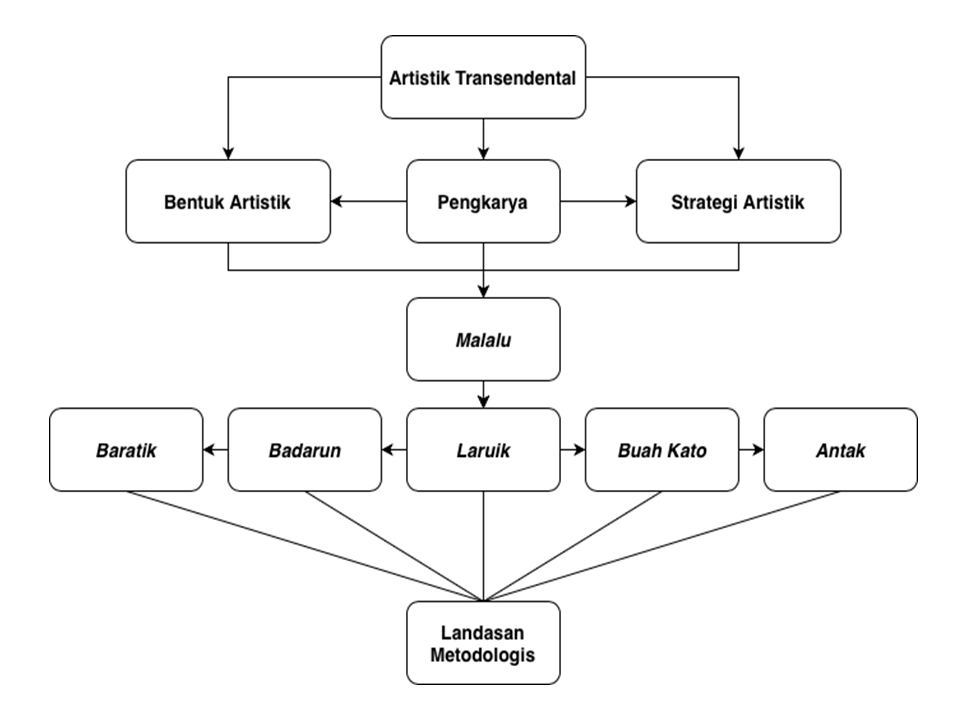
This article proposes Malalu as a novel transcendental artistic method that operates as a systematic framework for the creation of spiritually oriented music. Addressing the persistent issue of methodological ambiguity in spiritual art practices, this study formulates an approach that integrates inner experience, embodied awareness, and musical structure into a coherent compositional process. Using an artistic research approach and a case study of the Tarekat Bunyi composition, this article analyzes how the Sufi stages (takhalli, tahalli, and tajalli) are operationalized into observable musical parameters, including texture, density, bodily engagement, and collective relations. The findings demonstrate that Malalu functions not merely as a conceptual paradigm, but as an operational method that bridges Minangkabau local epistemology, Sufism, and contemporary spiritual composition. This study contributes to the development of artistic research by offering a context-based yet transferable methodological model for integrating spiritual experience into structured musical practice.
References
Brożek, A. (2011). Filozofia nowej muzyki – rediviva. Semina Scientiarum, 1(10), 10–20.
Cunningham, D. O., Sloan, D., & Shanks, S. T. (2021). The Routledge International Handbook of Spirituality in Society and the Professions. Edited by Laszlo Zsolnai and Bernadette Flanagan. London and New York: Routledge, 2019.(Reviewed by Deirdre O’Leary Cunningham.) The Challenge of World Theatre History by Steve Tillis. Cham, Switzerland: Palgrave Macmillan, 2020.(Reviewed by Dennis Sloan.) Over the Threshold, Into the World: Experiences of Transcendence in the Context of Staged Events by Kim Skjoldager-Nielsen. Stockholm: Stockholm University, 2018.(Reviewed by Samuel T. Shanks.): Reviews. Performance, Religion, and Spirituality, 3(2).
Dewey, J. (2005). Art as experience (Trade pbk. Ed.).
Djohan. (2016). Psikologi Musik. Indonesia Cerdas.
Emmerson, S. (2007). Living electronic music. Ashgate.
Ghaimbibie, G., & Mulyana, A. R. M. A. R. (2025). Music as Community Empowerment in the Process of Cultural Identity Formation in Tulang Bawang Barat, Lampung. Jurnal Sendratasik, 14(1), 85–103. https://doi.org/10.24036/jsu.v14i1.12
Guntur. (2016). Metode Penelitian Artistik. ISI Press.
Hajizar. (2008). ). Dimensi spiritual dalam barzanji maulid syaraful anam tarekat syattariyah di Bungo Tanjung Minangkabau. Institut Seni Indonesia Surakarta.
Hanif, A., & Fathy, A. (2023). DIMENSI SPIRITUALITAS MUSIK SEBAGAI MEDIA EKSISTENSI DALAM SUFISME JALALUDDIN RUMI. FiTUA: Jurnal Studi Islam, 4(2), 111–128. https://doi.org/10.47625/fitua.v4i2.508
Hartono, T. (2020). The Surau Suluk and Tradition of Ratik Togak: The Expression of Piety Among the Followers of the Tarekat Naqsabandiyah in Rokan Hulu, Riau. Sosiohumaniora, Vol. 22, No. 2.
Hernanda, A. H., & Barnawi, E. (2025). The Creative Process of Creating Nusantara Music in Edutainment Video Format. Jurnal Sendratasik, 14(4), 381–394. https://doi.org/10.24036/jsu.v14i4.36
Kafid, N. (2020). Sufisme dalam Dinamika Kehidupan Masyarakat Muslim Kontemporer. Mimbar Agama Budaya, 37(1), 27–38.
Labunets, V. M., Topchieva, I. O., Bondarenko, A., Bondarenko, D., & Wei, L. (2021). Innovative approach to training students of art pedagogical universities. Linguistics and Culture Review, 5(S2), 619–632. https://doi.org/10.21744/lingcure.v5nS2.1410
Landes, D. A. (2024). Merleau-Ponty. The Oxford Handbook of Modern French Philosophy, 219.
Merriam, A. P., & Merriam, V. (1964). The anthropology of music. Northwestern University Press.
Nettl, B. (2005). The study of ethnomusicology: Thirty-one issues and concepts. University of Illinois Press.
Ovadija, Mladen. (2013). Dramaturgy of Sound in Avant-Garde and Postdramatic Theatre. Montreal: McGill-Queen's University Press.
Oxenham, A. J. (2013). The Perception of Musical Tones. In The Psychology of Music (pp. 1–33). Elsevier. https://doi.org/10.1016/B978-0-12-381460-9.00001-8
Partera, S. A., Precillia, M., & Jaeni, J. (2025). Lighting design in enhancing narrative: An artistic analysis of the performance Senja dengan Dua Kematian adapted by Fathul A. Husein. Jurnal Sendratasik, 14(1), 1–13. https://doi.org/10.24036/jsu.v14i1.1
Pobihun, O., Arkhypova, L., Korobeinykova, Y., Kachala, S., & Hryniuk, V. (2024). An Analysis of Tourists’ Use and Assessment of Tourist Infrastructure in the Ivano-Frankivsk and Transcarpathian Regions of Ukraine. Studia Regionalne i Lokalne.
Prasetyo, N. (2020). Spiritualitas Dalam Musik. Deepublish.
Setiawan, E. (2015). Transformasi Makna Komunikasi Transendental Cak Nun Kepada Kiaikanjeng. Jurnal Komunikasi Islam (Journal of Islamic Comunication), 5(2).
Small, C. (1998). Musicking: The meanings of performing and listening. Wesleyan University Press.
Stubbins, W. H. (1954). The measurement of musical tone. Journal of Research in Music Education, 2(2), 135–145.
Sunarto, B. (2013). Epistemologi penciptaan seni. Yogyakarta: IDEA Press Yogyakarta.
Sunarto, B. (2020). Epistemologi penciptaan seni. ISI Press.
Suraiya, I., Rijal, S., & Prasojo, Z. H. (2019). Sufism and Religious Practices in Modern Lifestyle. Religió Jurnal Studi Agama-Agama, 9(1), 01–21.
Ural Federal University, & Sbitnev, V. S. (2024). The Concept of Spirituality in the Philosophy of Religion of D. V. Pivovarov. Koinon, 4(3), 97–107. https://doi.org/10.15826/koinon.2024.04.3.017
Downloads
Published
Issue
Section
License
Copyright (c) 2026 Indra Ariffin, Bambang Sunarto & Pande Made Sukerta

This work is licensed under a Creative Commons Attribution-NonCommercial-ShareAlike 4.0 International License.