The Concept of Tri Angga in Makeup and Costume Condong Legong Kraton Dance
DOI:
https://doi.org/10.24036/jsu.v14i3.23Keywords:
Dance, Tri Angga, Condong Legong Kraton, make up, costumeAbstract
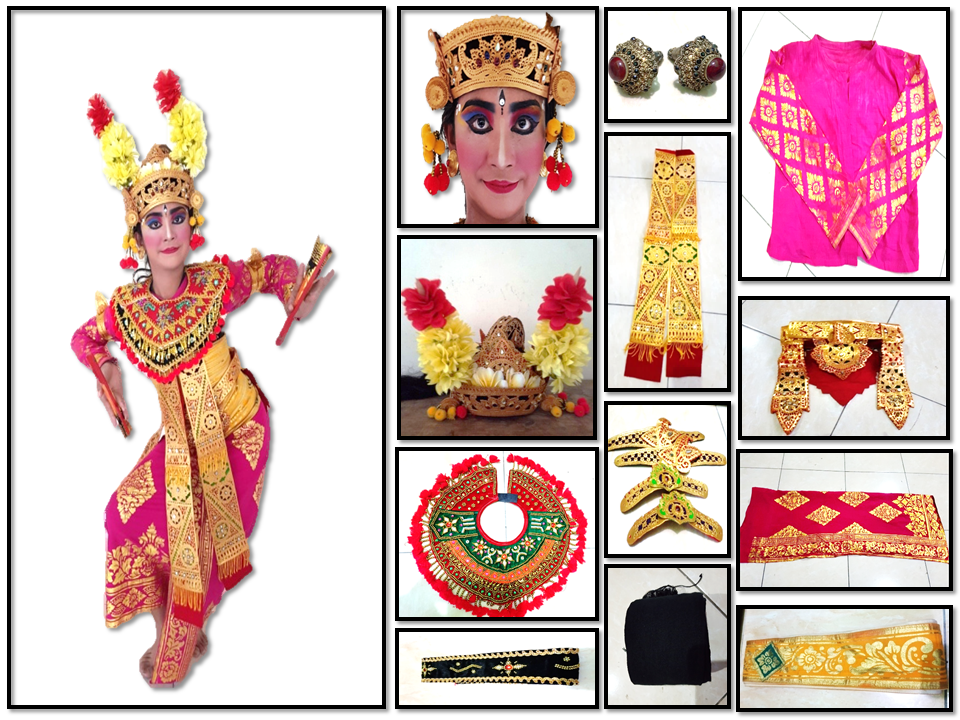
Condong Legong Kraton dance is one of the forms of classical Balinese performing arts that is rich in aesthetic value, philosophy, and symbolic meaning. One of the elements in this dance is the makeup and costumes. This study aims to identify the forms of makeup and costumes in Condong Legong Kraton dance and describe the meaning of makeup and costumes in Condong Legong Kraton dance in the concept of Tri Angga. This study uses a qualitative method with Charles Sanders Pierce's Semiotics as a tool to explore the meaning of makeup and costumes in Condong Legong Kraton dance within the Tri Angga concept. The Tri Angga concept is a Hindu religious concept that classifies the human body into three parts: Utama angga (head), madya angga (body), and nista angga (feet). The interpretation of makeup and costumes in several regions has often been reduced to merely visual elements, thus necessitating a deeper understanding of makeup and costumes in dance, particularly in the Condong Legong Kraton dance as a classical dance. The division of these concepts is as follows: Utama angga is the most sacred part, where the use of hair ornaments and facial makeup symbolizes the Trimurti (the gods Brahma, Vishnu, and Shiva). Madya angga is the torso or body, which serves as a medium for expression, and Nista angga is the lower part, which serves as the foundation and is integrated with life.
References
Arini, Ni Ketut. 2012. Teknik Tari Bali. Denpasar: Yayasan Tari Bali Warini.
Ariyasa, Putu, Darmawan Stah, Negeri Mpu, and Kuturan Singaraja. 2024. “KARAWITAN BALI DALAM FILSAFAT SENI LEO TOLSTOY.” Genta Hredaya: Media Informasi Ilmiah Filsafat Hindu 118–27. https://journal.stahnmpukuturan.ac.id/index.php/genta/article/view/223.
Armi, Rahayu Febri, and Herlinda Mansyur. 2022. “Bentuk Penyajian Tari Hari Langsung Tari Kreasi Masyarakat Kota Pekanbaru.” Jurnal Sendratasik 11:219–26. doi:10.24036/js.v11i2.114425.
Ayu, Kadek, Juni Aryani, Ni Made Arshiniwati, and Ni Luh Sustiawati. 2022. “ESTETIKA TATA RIAS DAN TATA BUSANA TARI BARIS KEKUPU DI BANJAR LEBAH, DESA SUMERTA KAJA, DENPASAR.” Batarirupa: Jurnal Pendidikan Seni 2(2):270–82. doi:10.5281/ZENODO.7672810.
Bagus, Ida, and Gede Subawa. 2024. “Agama Hindu Dan Budaya Bali: Warisan Luhur Dalam Kehidupan Modern.” Kamaya: Jurnal Ilmu Agama 7(4):104–13. doi:10.37329/KAMAYA.V7I4.3805.
Bagus, Ida, Nyoman Wartha, Wayan Gede, and Purna Martha. 2021. “FUNGSI TARI GAMBUH DALAM UPACARA DEWA YADYA DI PURA DESA ADAT BATUAN, KECAMATAN SUKAWATI, KABUPATEN GIANYAR.” Jurnal Santiaji Pendidikan (JSP) 11(3). https://e-journal.unmas.ac.id/index.php/jsp/article/view/3092.
Bandem, I. Made. 1983. Ensiklopedi Tari Bali. Denpasar: Dinas Kebudayaan.
Bandem, I. Made. 2004. Kaja Dan Kelod: Tarian Bali Dalam Transisi. Yogyakarta: Institut Seni Indonesia.
Dibia, I. Wayan. 2012. Taksu Dalam Seni Dan Kehidupan Bali. Denpasar: Bali Mangsi Foundation.
Dibia, I. Wayan, &. Ballinger, R. 2004. Balinese Dance, Drama & Music. USA: Periplus.
Hidayat, Puji Maharani, and R. Indriyanto. 2025. “Topeng Ireng Wira Catra in Wanurejo Vil-lage Magelang District: An Analysis of the Development of Performance Form and Function.” Jurnal Sendratasik 14(2):1–16. doi:10.24036/ADXG2355.
Malahati, Fildza, Anelda Ultavia B, Putri Jannati, Qathrunnada Qathrunnada, and Shaleh Shaleh. 2023. “KUALITATIF : MEMAHAMI KARAKTERISTIK PENELITIAN SEBAGAI METODOLOGI.” JURNAL PENDIDIKAN DASAR 11(2):341–48. doi:10.46368/JPD.V11I2.902.
Nengah Kadek Selamet, I Wayan Suja, and Ida Bagus Putu Arnyana. 2025. “Dari Pura Ke Ke-las: Menanamkan Nilai-Nilai Tri Hita Karana Dalam Transformasi Pendidikan.” Journal of Education Action Research 9(2):326–32. doi:10.23887/jear.v9i2.89917.
Nuryani, Wenti, Suminto A. Sayuti, and Dwi Siswoyo. n.d. “Nilai-Nilai Pendidikan Tata Busana Dan Rias Srimpi Pandhelori Dalam Perspektif Hermeneutik.”
Putri, Okta Piana, and Afifah Asriati. 2023. “Penerapan Tari Persembahan Beras Kunyit Da-lam Kegiatan Ekstrakurikuler Upaya Pelestarian Tari Tradisional Di MTsN Sarolangun.” Jurnal Sendratasik 12:280–89. doi:10.24036/js.v12i2.120569.
Rijal Fadli, Muhammad. 2021. “Memahami Desain Metode Penelitian Kualitatif.” 21(1):33–54. doi:10.21831/hum.v21i1.
Sari, Afifah Wulan Aprilia, and Yusria Fahmiana. 2025. “ANALISIS SIMBOL FILOSOFI TATA RIAS DAN BUSANA TOKOH SUPRABAWATI DALAM WAYANG WONG GAYA YOGYAKARTA.” Jurnal Sitakara 10(1):12–20. doi:10.31851/SITAKARA.V10I1.15150.
Subhaktiyasa, Putu Gede. 2024. “Menentukan Populasi Dan Sampel: Pendekatan Metodologi Penelitian Kuantitatif Dan Kualitatif.” Jurnal Ilmiah Profesi Pendidikan 9(4):2721–31. doi:10.29303/JIPP.V9I4.2657.
Suhendra, Eka Ari. 2023. “Cultural Communication through Gambuh Dance : A Historical Performing Art from Bali.” Bali Tourism Journal 7(3):43–46. doi:10.36675/BTJ.V7I3.95.
Suryadana, I. Putu Putra, I. Wayan Mudra, and I. Nyoman Suardina. 2021. “Kajian Bentuk, Filosofi Ornamen Dan Konstruksi Sanggah Rong Tiga Hindu Di Bali.” HASTAGINA: Jurnal Kriya Dan Industri Kreatif 1(01):8–17. doi:10.59997/HASTAGINA.V1I01.68.
Downloads
Published
Issue
Section
License
Copyright (c) 2025 Ni Luh Enita Maharani

This work is licensed under a Creative Commons Attribution-NonCommercial-ShareAlike 4.0 International License.